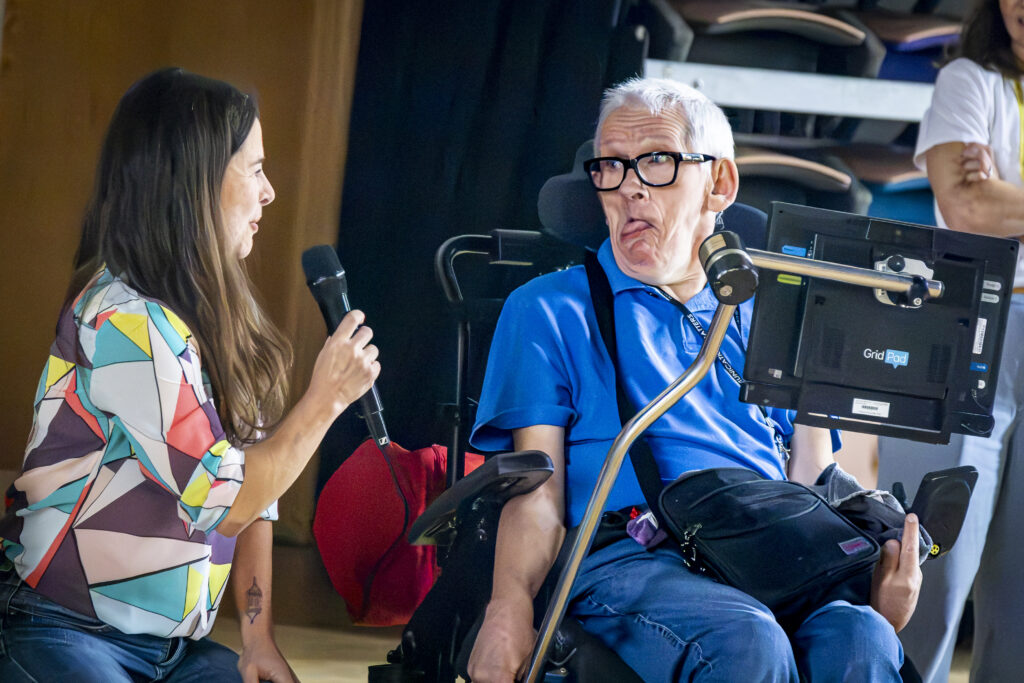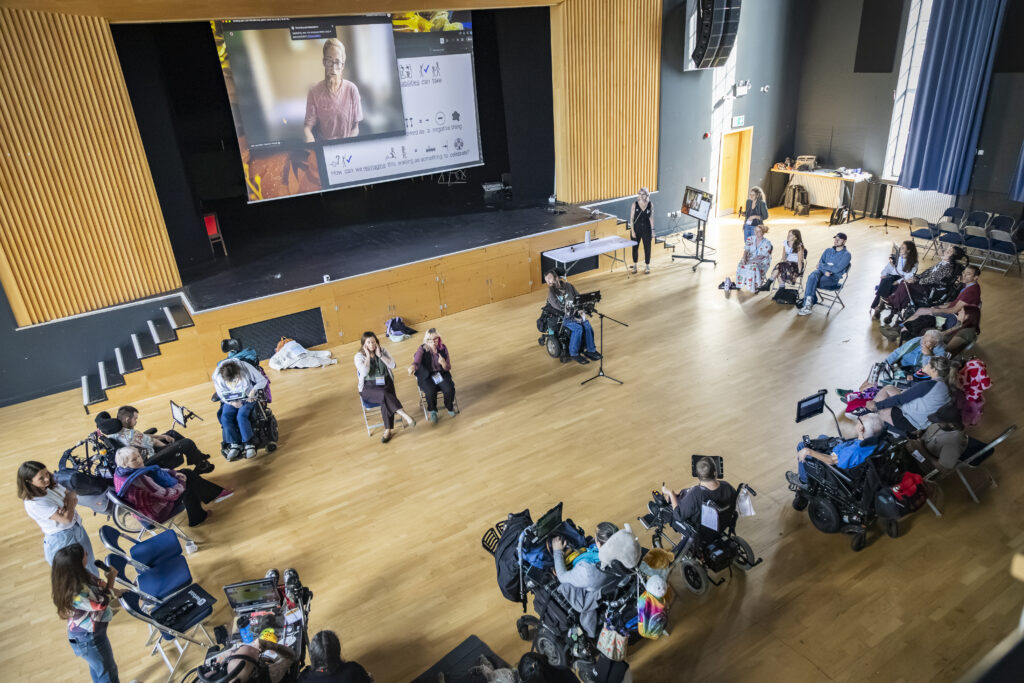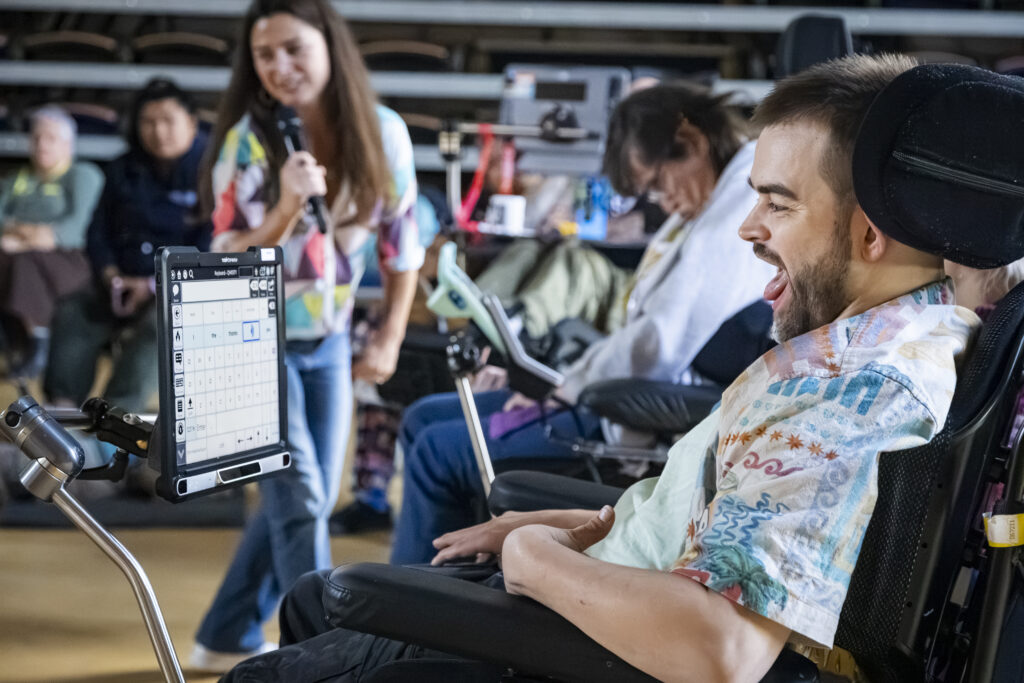
This article is written in response to the screening of an AAC user creative workshop held in advance of the Communication Matters International AAC Conference in 2027 at University of Leeds.
All opinions expressed are the writer’s own. Communication Matters does not endorse specific products. For details of assessments, services and suppliers, please see the About AAC pages: About AAC Systems, Assessment Services and Information Days & AAC Suppliers.
The workshop this year was delivered by the Stories Beyond Words Collective who are a collaborative film-making team who make films exploring the social identity of people living with communication impairments and using AAC through co-produced short films[1]. During the CM AAC users’ workshop, the collective’s film Dysfluent Journeys was shown, and the discussion below narrates my reactions to this work from both an arts and social science perspective.
Post conference, delegates were asked to reply to the following three questions;
The discussion below is drawn from my replies to these questions, this approach serves as an example of a research method that can be used without any specialised training.
The way in which the film represented Jamie was particularly striking, the close ups of Jamie’s face, with the wind blowing in his hair made him appear like a character in a television drama. Such a representation made for a striking balance between Jamie simply as a person, and Jamie as an AAC user.
In relation to the camera shots etc, this film was made using a special type of camera that can be mounted on a person’s wheelchair, allowing for 360-degree angle shots. The close-up shots of Jamie’s face accentuating his personhood have already been commented on. Complimenting this are the ariel shots of Jamie’s lap, followed by shots of his Voca screen while he is preparing a message. The point of view of a wheelchair and a Voca user was powerfully portrayed through the vertical shots of Jamie’s lap. During his narration, he remarks on how people he is communicating with become confused because they are unaware that he is preparing a message, the shots of Jamie’s Voca screen will go some way towards ameliorating this. All of this sequence is filmed in a busy high street and shopping centre, giving emphasis to the place of AAC users in contemporary society.
The creative approach taken by the Stories Beyond Words Collective has a particularly powerful potential to draw nondisabled people into the lifeworlds of AAC users and those with disfluent speech. Skilful camera work, and other qualities of direction such as the fading of Jamie’s surroundings to the vertical shots of his Voca while in use could offer the none disabled viewer a closer glimpse of the world from the viewpoint of an AAC user or someone with disfluent speech.
I found it intriguing to compare my reactions to Christine’s portrayal from that of Jamie’s. Christine has what is sometimes referred to as a hidden impairment or disability. In other words, Christine’s impairment is not apparent until she begins to speak. Christine begins her narration by stating that she feels that her stammer is part of who she is , “it is part of me. It’s not an add-on”. Christine related how she has experienced bouts of fluency after engaging in speech therapy, and although these can be pleasant, she describes them as feeling not like herself, “As if my brain wanted to go back to the stammer”. I related to the way in which this narration raised the question; ‘for who’s benefit is fluent speech’? As someone who uses revoicing as part of their AAC strategy[2], Christine’s experiencing her stammer as part of her sense of self resonates with choosing revoicing over using a Voca on occasions.
Moving on to consider the composition of Christine’s sequence, the split screen shots of her legs from the top down on the one side, and a rear view of her walking into the distance, powerfully illustrates her comments describing fluency as pleasant but somehow alien to her sense of self. This sequence could be viewed as; the Christine of the vertical walking legs represents how she sees herself, whereas the Christine walking into the distance represents society’s expectation and often demand for fluency.
The effect that the film may have on the public’s perception of people with communication impairments is probably best considered from the point of view of a teaching aid to be used in disability equality training. The close-up shots of Christine’s face combined with the narrative culminate in a creative approach with the power to change attitudes.
Emily’s representation resonated with me the most as we share the same physical and speech impairments. In my earlier research I endeavoured to identify the politics of living with a speech impairment, Emily highlights one aspect of such a political analysis when she speaks of the importance of the people she is speaking to asking her to repeat a word or phrase until both parties feel confident that it has been understood. I was able to completely identify with the excellence with which the film articulated the crucial importance of co-constructed communication.
The production of Emily’s sequence cast my mind back to watching the disability campaigner Richard Shaw in a film about the Derbyshire Centre for Inclusive Living during the early 1990s. Shaw’s speech was clear, and the similarities between the camera work in Emily’s section, combined with her narration in dysarthric speech with subtitles made me think our (as in people with disfluent speech and AAC users) time has come. The wonderful thing about Emily’s sequence is that it does resemble those videos, but at last this is someone with dysarthric speech talking about the politics of dysarthria! “Give me time, and don’t talk over me” this is exactly what I am referring to by the politics of dysarthria”. The footage of Emily travelling in her car while explaining the importance of not pretending to understand her speech, demonstrates the importance of co-construction and embodied communication that is so long overdue. This is an expert from lived experience talking about how conversation partners need to behave in order to enable and empower people with communication impairments.
The creative approach chosen by Stories Beyond Words affords people with communication impairments space to share thoughts and experiences without being interrupted. Hearing Emily speak with the opportunity of reading her narration in subtitles will make people reflect on whether they give people sufficient opportunity to make themselves heard.
When we come to the third contributor in the film Greta, the viewer’s attention is rightly drawn towards her creative work as a painter, film director and musician over that of a disabled person. It’s evident that Greta uses eye gaze, and it is this narration that draws the viewer’s attention to what technology enables Greta to do, as opposed to her communication impairment or her voca. The artist in Greta is represented in the way in which repetitions of words and phrases feature in her narration. Towards the end of Greta’s sequence, her narration makes explicit the creative use to which she puts her Voca; “I use my communication pages to give my creative assistants instructions”.
Again, there is a striking of a balance in Greta’s sequence between Greta the person, Greta the Voca user and most importantly Greta the creative! This is emphasised by the sequence being filmed with Greta seated in the front of an assisted cycle, with her mobile phone and Voca clearly visible on mounts. The mount of her mobile phone is rotating, apparently in response to the motion of the cycle, suggestive of Greta’s film making expertise, the panning of green spaces in Greta’s sequence further accentuate her skill and identity as a film maker. For Greta being a creative herself, the Stories Beyond Words approach provides her with the opportunity to showcase her talents and abilities. Alongside her narration the film demonstrates that AAC users and disabled people can achieve just like anyone else given the opportunity and right support.
The nature of Anne-Marie’s impairment being different from that of my own in no way diminished the extent to which her narrative resonated with me. In common with Christine, Anne-Marie speaks with a stammer. Her narration explains how she was empowered to take “ownership and control” of her disfluent speech when the university she attended asked her for the first time in her life how she wanted to deal with instances where she stammered. She states during the film, “I think that small shift in mindset was really key and really pivotal part, and where my journey of acceptance really started”. I had a similar epiphany during the Stardust project when a SLT explained the distinction between Cerebral Palsy and Dysarthria. How this acceptance by Anne-Marie led to the rejection of ableist attitudes towards stammering is beautifully illustrated when she talks about how people should not praise her for speaking fluently and instead praise her for employing work arounds”.
For Anne-Marie, through the creative approach she had the opportunity to chart and share her own journey through acceptance to advocate. The Equality Training feel of the video returns when she explains that “work arounds” should be celebrated as opposed to episodes of fluency. All participants in this film have through the creative approach they have chosen provided themselves with time and space to share their experiences of either using AAC or having disfluent speech, in doing so, viewers of the film should see the world from these perspectives and adopt more cooperative attitudes.
So, what did I learn from attending the AAC user’s session at the 2026 Communication Matters Conference? I learnt that AAC issues are making inroads into the wider disability equality agenda. I learnt that I was correct in believing that the arts can and should complement our understandings of our experiences offered by the social sciences. But most of all I learnt that I am not alone, that I belong to a worldwide community, all seeking the same social change as myself!
[1] Google search “stories beyond words film collective”. Accessed 09/11/2026
[2] Toogood, J. et al (2025) ‘Rejoice the Revoice! Exploring the Concept of Technoableism in relation to AAC’ Communication Matters / ISAAC (UK). 39(3) pp 5-9
The creative approach chosen by Stories Beyond Words affords people with communication impairments space to share thoughts and experiences without being interrupted.
Hearing Emily speak with the opportunity of reading her narration in subtitles will make people reflect on whether they give people sufficient opportunity to make themselves heard.
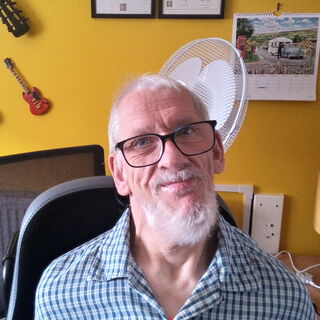
Jonathan Toogood